Hydrogen Bonding Is a Special Case of
A London-dispersion forces B ion-dipole attraction C dipole-dipole attractions D ion-ion interactions E none of the above 4 When NaCl dissolves in water aqueous Na and Cl-ions result. It is alsovital that you refer to the hydrogen bonding as.
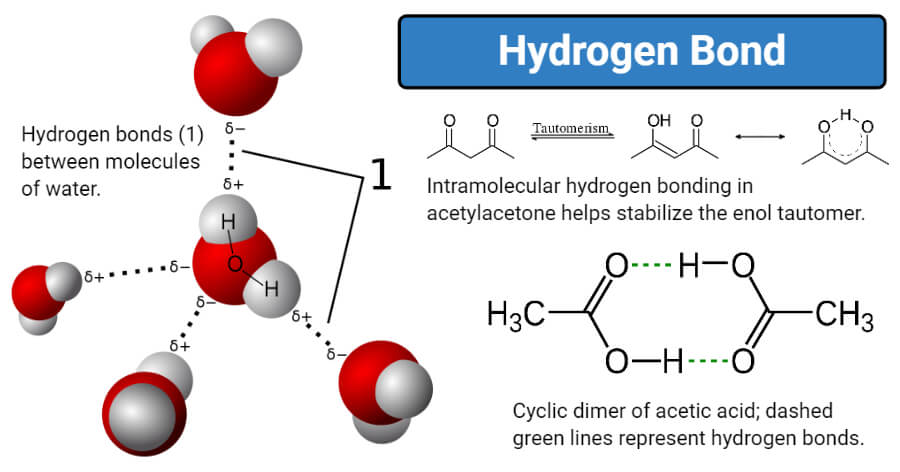
Hydrogen Bond Definition Properties Types Formation Examples
Hydrogen bonding is a special case of permanent dipole-permanent dipole bonding.

. Hydrogen bonding is a special case of very strong dipoledipole interactions possible among only certain atoms. And thats because hydrogen bonds can be viewed as the strongest form of dipole-dipole forces. The force of attraction that exists between Na and H 2.
3 Hydrogen bonding is a special case of _____. A London-dispersion forces B ion-dipole attraction C dipole-dipole attractions D ion-ion interactions E none of the above. In certain molecules in where the difference in electro-negativities between the different atoms is high enough then even stronger dipole dipole forces will be form which are known as hydrogen bonding.
Hydrogen bonding is a special case of _____aion-dipole attractionbdipole-dipole attractionscLondon-dispersion forcesdnone of the aboveeion-ion interactions. Slide 4 59 4 When NaCl dissolves in water aqueous Na and Cl-ions result. How does the small size of the hydrogen atom contribute to the unusual strength of the dipole-dipole forces involved in hydrogen bonding.
Hydrogen bonding is a special type of dipole-dipole attraction between molecules not a covalent bond to a hydrogen atom. Hydrogen bond is really a special case of dipole forces. What atoms in addition to hydrogen are necessary for hydrogen bonding.
Hydrogen bonding is a special case of very strong dipoledipole interactions possible among only certain atoms. D mainly hydrogen bonding but also dipole-dipole interactions. It is implied that hydrogen bonding is a special case of very strong dipole-dipole interactions possible among only certain atoms.
When NaCl dissolves in water aqueous Na and Cl- ions result. -Dispersion forces are mainly responsible for hydrogen bonding interactions. Chemistry questions and answers.
Usually the electronegative atom is oxygen nitrogen or fluorine which has a partial negative charge. What atoms in addition to hydrogen are necessary for hydrogen bonding. The only possible atoms with a high enough electronegativity are N O and F.
It results from the attractive force between a hydrogen atom covalently bonded to a very electronegative atom such as a N O or F atom and another very electronegative atom. Hydrogen bonding is a very special intermolecular force that occurs in polar molecules when a hydrogen atom is bonded to a highly electronegative atom. So because we also know that and we know that any molecule it contains these groups is going to have a die poll we know that this is going to.
Usually the electronegative atom is oxygen nitrogen or fluorine which has a partial negative charge. A London-dispersion forces B ion-dipole attraction C dipole-dipole attractions D ion-ion interactions E none of the above. Chemistry questions and answers.
None of the above14Which of the following has hydrogen bonding as its only intermolecular force. Intermolecular forces IMFs occur between molecules. The hydrogen then has the partial positive charge.
The hydrogen then has the partial. Hydrogen bonding is a special case of _____. On a phase diagram the melting point is the sameas_____athe boiling pointbthe.
P C S A 19. The force of attraction that exists between Na and H2O is called an _____ interaction. It is important to be clear that although it is called hydrogen- bonding it really is an intermolecular force.
Know that a hydrogen bond is ah in a molecular bond between hydrogen with a partially positive charge and it sufficiently electro negative act Adam with a partial negative charge which is an oxygen nitrogen or boring. Bolivianouft and 2 more users found this answer helpful. Sign In to Writing Essays Science.
A hydrogen bond is the attractive force between the hydrogen attached to an electronegative atom of one molecule and an electronegative atom of a different molecule. C N O d. Chemistry QA Library How does the small size of the hydrogen atom contribute to the unusual strength of the dipoledipole forces involved in hydrogen bonding.
11 Hydrogen bonding is a special case of A ion-ion interactions B ion-dipole attraction C dipole-dipole attractions D London-dispersion forces E none of the above 12 The predominant intermolecular force in CH32NH is A dipole-dipole forces B ionic bonding C hydrogen bonding D London dispersion forces E ion-dipole. A hydrogen bond is the attractive force between the hydrogen attached to an electronegative atom of one molecule and an electronegative atom of a different molecule. They are so strong that they seem like weak covalent bonds.
True or false -Hydrogen bonding is a special case of dipole-dipole interaction. The force of attraction that exists between Na and H. What atoms in addition to hydrogen are necessary for hydrogen bonding.
For hydrogen bonding my understanding of it is that they are just a special case of dipole dipole forces. 13Hydrogen bonding is a special case of __________. When were talking about hydrogen bonds were usually talking about a specific bond dipole the bond between hydrogen and a more electronegative atom like nitrogen oxygen and fluorine.
Hydrogen bonds are a special case of dipole-dipole forces. E mainly London-dispersion forces but also dipole-dipole interactions. C London dispersion forces.
The hydrogen bond is really a special case of dipole forces. Hydrogen bonding is a special case of very strong dipole-dipole interactions possible among only certain atoms. A hydrogen bond is the attractive force between the hydrogen attached to an electronegative atom of one molecule and an electronegative atom of a different molecule.
F O N c. Thus the name hydrogen bond. Why does the small size of the hydrogen atom contribute to the unusual strength of the dipoledipole forces involved in hydrogen bonding.
A hydrogen bond is an intermolecular force IMF that forms a special type of dipole-dipole attraction when a hydrogen atom bonded to a strongly electronegative atom exists in the vicinity of another electronegative atom with a lone pair of electrons. How does the small size of the hydrogen atom contribute to the unusual strength of the dipoledipole forces involved in hydrogen bonding. 3 Hydrogen bonding is a special case of _____.
The hydrogen bond is really a special case of dipole forces.

A Hydrogen Bond Msrblog

A Hydrogen Bond Msrblog
007 Hydrogen Bonding Water Hydrogen Bond Bond Molecules
Comments
Post a Comment